

Process
Background: How it all began.
While working in the package industry in Toronto I became exposed to a deeper side of consumerism and waste than I had previously been aware of. I began to see how much waste is really created behind the scenes just so that companies can market their products to us, even if we may not really need them. I wanted a way to show our real values, our impact on nature and to show that there are more eco friendly alternatives.
This is the first leaf that I ever painted. I wanted to highlight how I saw Northern Ontario, hockey, outdoors, on a maple leaf.
I figured by painting on leaves, it would avoid; the tree being cut down, transportation for processing, being processed into pulp, the pulp material shipped to be created into paper or canvas, if it’s paper it is pressed, if it’s canvas it’s processed, finished and stretched onto other wood, each would then be packaged, maybe at a secondary facility, and then shipped again to a retailer.
Leaves are already dropped each fall as trees conserve their energy for the winter. Leaves are important for the tree. They decompose and return any left over nutrients into the soil. They also serve as overwintering habitat for many insects and invertebrates, including many beloved butterfly species. I never collect more than a few leaves from a particular area. By painting on leaves, I have a much smaller impact on the environment than conventional art substrates.
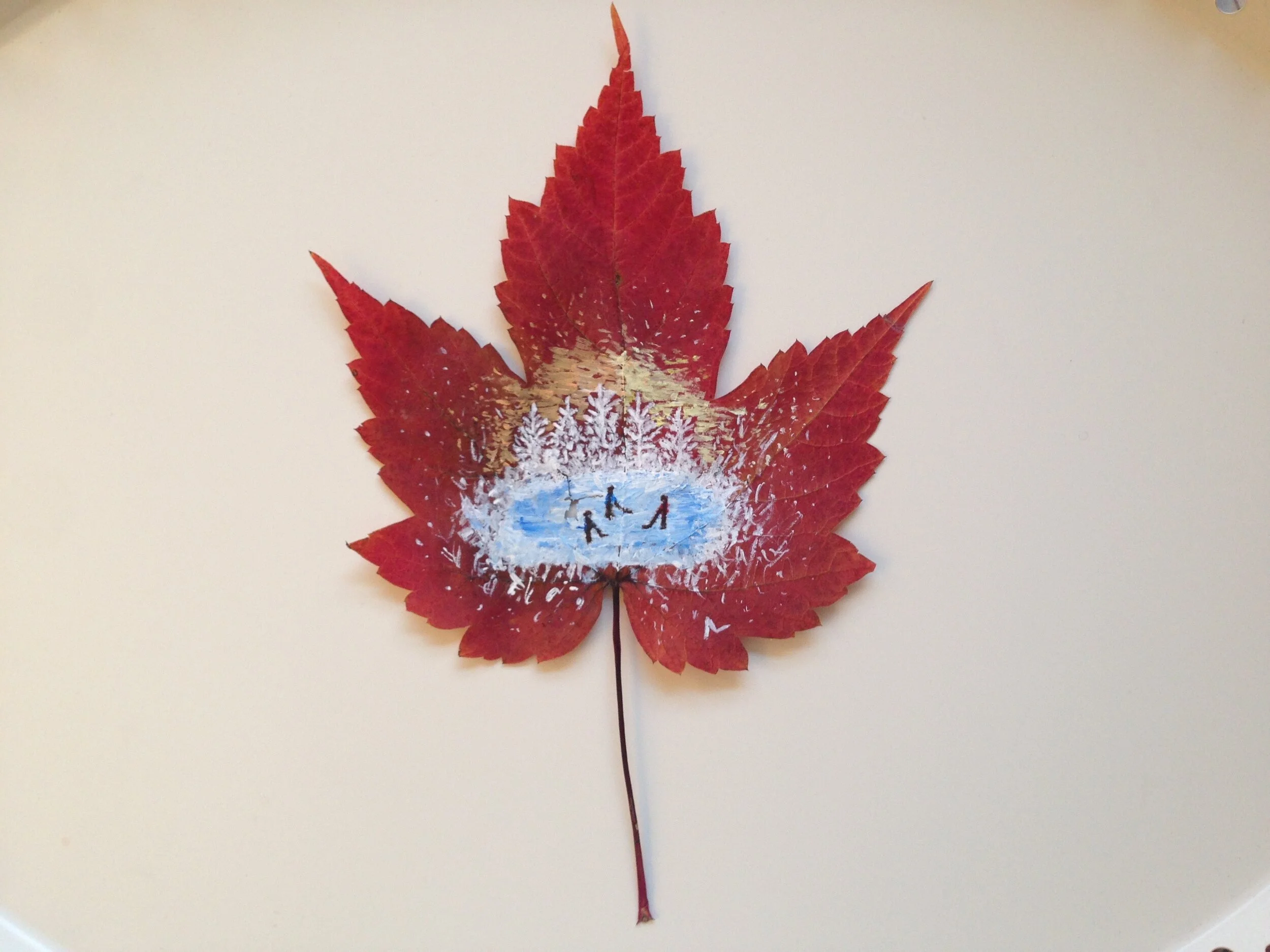
First leaf painted, November 2015.

Working With Nature
Each leaf is carefully collected in the fall. Most are from Northeastern Ontario, but I’ve been fortunate enough to have explored some areas of Southern Ontario and now British Columbia!

At the time that I began this leaf painting journey, I became increasingly interested with nature and wildlife. I began reading a lot of nature books and wanted to highlight Canadian wildlife, especially Species at Risk and the habitats they need to survive. Each of these are greatly effected by what humans do, even if it is not a direct impact.
One of my most profound influences came from zero-waste queen Lauren Singer and the one and only Jane Goodall. These women have successfully broken boundaries in their own industries by being true to themselves, following their passions and for calling to action what they believe is the right thing to do, even if it may not be the easiest or most popular way to do things.
Each piece of artwork starts from a piece of information I’ve read or from something I’ve seen in nature that has inspired me.
This may be a wildlife fact or just simply the feeling while watching a really wonderful sunset.


View from the Top, 2018.
After a piece is planned out and the sketch completed, I get to work to bring the idea to life. This is usually done while listening to the radio or podcasts (Backstage at the Vinyl Cafe is one of my favourites).

Grizzly Bear Sunset, 2018.
Paint
Liquitex Basics acrylic paints is used for all of my paintings. Although this is not an eco-friendly paint, the packaging that they come in is easily reusable. Unlike many paints that come in foil tubes which are not able to be recycled, Liquitex Basics come in large, clear plastic tubes that have removable caps. This makes it easy to wash an empty tube and refill it to reuse. I use mostly primary colour paints with the exception of a few premixed colours. I do the rest of the colour mixing myself which helps to keep my packaging waste collection to a minimum and also allows me to create unique colours.
My paint palette was cut from a piece of scrap plywood. This wooden palette prevents me from creating waste from disposable paint palettes and it only looks better with more paint on it, so I don’t have to worry about cleaning it and putting unnecessary paint waste down the drain or into the garbage. I also have an evaporation station set up for paint water to ensure minimal paint residue ends up down the drain.

An assembly of new pieces for the Spring of 2018 (spot the paw of my painting assistant on the left).
One of the last steps to a final piece is the framing. I do all of the framing myself. I have experimented a lot over the years but have found that repurposing vintage frames aligns best with this artwork. These often have to be refinished or upgraded but extend the life cycle of an item already created and available locally. I have also built my own frames from repurposed wood. These are now mostly used for special projects or odd leaf sizes.

Vintage frames sanded down and ready to be refinished.

Frame built from repurposed wood, set with non-reflective art glass.
Finally each piece is packaged with care. Local pick up/drop off pieces are of course the most efficient and earth friendly delivery but I ensure pieces travelling long distances make it safely. Every shipped item is carefully protected and packaged to arrive safely, in as much repurposed packaging as possible. We hope you are able to reuse or donate (to your local thrift store) any suitable packaging to extend its life cycle.

Artwork wrapped and ready for local pick up.